20 June, 2016

Lost Consciousness

In the rustle of men shoving past each other
to be a minute sooner to their destination
In the land of crowds and speed, and wants and needs,
I take a break to get away from the madness
To look for respite, in some place afar
Without maddening crowds and no end times
where I can spend time listening to inner voices
which seem to have shut down for the moment

I reach for a plane, giant bug in the sky
which takes me above, away from the traffics
I look out to images surreal, of layers and layers of clouds
layer after layer, protecting one another
And between 2 such sheets, emerges the mighty sun
Lights reflected on clean sheets and angels beckon to man
to conquer them to walk on them
To wish to spend my life amongst them
The beauty the sight remains in my heart
For I need to leave it, for my journey has reached a halt

I drive amongst mountains, mighty and old
I wonder how what they’d have seen, since their births from yore
I wonder how they grew, fighting land and man alike
Or did they never care, and simply reach for the skies
Maybe if it didn’t rain out here, they’d have not been so rocky
maybe they’d be smooth, not having to had fought the storms
Virgin mountains, bereft of rains, unscarred, innocent, reaching for skies
Would they have been different, if not for their fights?
Perhaps the struggle was necessary, as told by the flowers which grow on them
for what even would be the point, of rock simply reaching sky
I wonder how He designed the world, where flowers grow on rocks
all it takes is a little struggle, and a lot of patience
Again and again my mountains were washed,
and again and again they grew further still
Finding new strength, to protect their children
Or for personal ambition, they never failed or listened
Perhaps that is their lesson, stoical hard yet gentle to love
Unfailing, unsmiling, living on in the world

Just then showers break
my clouds have come to life
Floating up there in the air as masses of specks
They choose to pour as water might
They drench me in love and terror
making me one with what I’d admired
its not the same as I had imagined
but I guess that’s how life works

I find shade and think of my struggles
So real in another world, yet illusions of some distant reality here
Yet this moment of mine shall soon be a memory
when I go back and fight my own times
Never have I ever called out to God for help during those days
Being atheist, I disregard such non-sense outright
I think I don’t deserve the right to believe in miracles of Hers
No, my struggles have been mine and mine alone
For the universe has never made things right for me
The universe has never played it right
and I don’t think the universe ever will
So I miss the connection so many feel
I miss the sense of false protection I may have chosen to have
And as I fight with aggressive and calm believers alike
I fight my battles alone, while being asked to believe
And believe I refuse to do, for already have I lost much to faith
For keeping faith hath never done me any good
and I lack the patience of waiting lame

In the calm of surreal natural beauty
I look upon in silent contemplation
Amongst clouds and mountains and rains and Gods
I hunt for peace I cannot find
For failed have I to search within, failing still failing will
Trying to find meaning in a universe without one
trying to look for inner voices now dead
I realize, I might be lost forever

Vishal Gupta
6 April 2016


06 June, 2016

Skies of Rust

Scars resurface when demons awaken
With grief, sorrow, remorse they threaten
Plagued memories make way to the soul
Death remains but the last boon for the bold

Hollow words now whet the times
Sans meaning, they stand divine
God looks, angry once now tired
For souls of men the devil has sired

Tears remain for those who think
Voices are crushed, brought to the brink
Winds from lungs too curb
The brave escape, the servile serve

Held hostage to our own affections we are
The struggle is within, not afar
Desires of a tranquil moment of peace grow faint
To be laid down one final time we lament                                                                                                            
Vishal Gupta
August 21st, 2015


26 May, 2016

Lost Warmth

2 years had gone by, but the morning ritual had remained unchanged. Every morning, she would bring two cups of hot coffee to start his day. They had been through so much over those precious moments shared every morning. Fights settled, promises made, kisses shared, all with a sweet warm breath. She remembered how it had started… it was their honeymoon and she had woken up before him. Not wanting to wake him up, she decided to make some coffee for herself. He woke up from the sound of the pot and she offered the cup to him, which he accepted with a smile. That smile… she had never seen him smile like that in their year of courtship and she knew as long as he had that smile, there was nothing the two of them couldn’t go through. All she had to do was ensure he began every morning with the same smile, which he did till date. No words had ever been spoken. He had never asked. He had never needed to. The ritual had simply manifested itself.

She had come into his life hardly prepared for anything life would throw at her. Within a day, her life had turned around and she was not equipped to face it. Her mother had tried hard to instill some “household” manners in her, but she never bothered. As long as she could make Maggi and coffee, she could feed her husband, she used to think with a twinkle in her eye. Now she knew her words were true when in the middle of his sips he would sometimes silently come close to her and hold her in his arms, letting her know that her deficiencies didn’t matter to him. Sometimes, not often, he would allow small words of comfort to escape his lips.

The day of her miscarriage, he had brought her back from the hospital and simply laid her down on the bed without a word before going to sleep on the other end. The next morning, he woke her up with a cup of coffee for himself and a glass of warm water for her, taking her in his arms once again and telling her not to worry. Those were the only words she needed to hear. They had sounded so meaningless when the doctor had said them. Right now, they brought life back in her soul and she cried. Tears which had been held back then came rushing out now and he wiped every one of them. As long as he was there with her, no tear of hers would ever fall, she thought as she felt the taste of coffee on her lips. Coming back from the memory, she poured the bubbling liquid in two cups and made her way to their room.

As his bride walked in with coffee, he woke smiling… remembering the fragrance of his Aai’s coffee.

Vishal Gupta
October 2014


03 April, 2016

The Harbor Line 8/8 - Journey

A long time ago I’d read that every city has a word. For Rome it’s “SEX”, for Vatican it’s “POWER”, for New York its “ACHIEVE”, for Haridwar it’s “FAITH”. I have long wondered what the word for Mumbai is.

It’s “MOTION”. It’s easy to confuse Mumbai for a money hungry city with no soul. It’s difficult to think of Mumbai moving seeing hundreds of people idling about at the shores of the Arabian Sea after sunset on a weekend. But if you live here long enough, you realize that this city cares little for idle chats and somewhat lesser about money than what you’d expect. Mumbai earns, but Mumbai spends.

I come from a Maadu city where people hold the opinion that any expense should transform into an investment. Otherwise it is a waste of money. Mumbai doesn’t care. People here want to see their money move, even if it doesn’t grow. Maybe it’s the stress which is inherently built into Mumbai’s lifestyle. If that can be alleviated on a weekend by watching a play for 3,000 bucks, why not? But you need to keep moving.

I think it comes from to each Mumbaikar by design of the city. For no one grows up in Mumbai without being pushed inside a crowded train. No one ever thinks twice about taking up a job 3 hours away from home and spending a quarter of their day in travel. Being raised in such an environment, you get tuned to keep moving. You become impatient like the crowd. And life becomes a constant struggle to move ahead.

In many ways these trains represent everything Mumbai is about. A class divide. Crowd. Motion. Structure. Trade. Struggle. Friendship. Fear. Courage. And most importantly, movement. Moving on.

I remember the other day in the train I was engrossed in my Kindle that I completely forgot that the station had arrived. Not that it mattered. It was the last station and an emptying train would surely catch my attention. As I realized the station had come I packed my Kindle in my bag and started getting down when I heard the words, “Who’s bag is this? Get down fast!” Apparently someone had forgotten their bag in the overhead compartment and gotten off the train. Now in most parts of the world this would be a sight ignored. Or perhaps a good seminarian would take the bag to the lost and found section on the station. But for Mumbai, this was terror. At first I did not understand why people were running out of the train in sheer terror at the sight of the bag. It was a harmless bag. But more I thought about it more I realized that trains were a vulnerable point in Mumbai’s security. With a hostile neighbor attached to Mumbai by the sea, Mumbai had been a victim of repeated terror strikes in the past. Even though the last one had been 8 years ago, the memory of a 21 year old boy with a machine gun in one hand, and blue bag slinging on the other, on this very train station was still etched clearly in the memory of these people. It was a morning pretty much like that one. The station must have been as crowded as it was that day. And the people would have had been as unsuspecting. Proceeding to begin another day of firefighting with their jobs. Little did they know that it would be the last day of their lives. Mumbai remembered this. But Mumbai moved on. This city does not stop for anything. Not the wrath of Gods or men. Because that is what Mumbai is about. Moving on.

As time moves on, so does Mumbai. It is not a very old city. In fact till 1845, geographically it didn’t even exist as a single landmass but only as a collection of islands. Maybe that’s the reason the sea could never truly leave its hold on Mumbai and sends showers every year to try and reclaim its lost child. In the short span this city has been in existence, it has grown to account for nearly 10% of the country’s GDP. Most people would agree that this is an amazing feat and Mumbai is the most developed city in India. Others are obviously Delhites.

Still, as the Harbour Line moves down Central Mumbai, one cannot help but notice the heaps of garbage alongside the train tracks. To an amateur economist like me, dumps of plastic are also an indication of a flourishing economy, but one can’t help but wonder if the cost of such development is worth it. Those who are responsible for the mess are seldom affected by it, leaving the poor to grapple with the problems. An interesting thought came to my mind when I visited one of the many flourishing offices in Lower Parel, as shown in the picture below. There were air-conditioners on almost every window, and no single window was open. It wasn’t summer time in Mumbai, and I daresay the wind was pleasantly cool. Yet it didn’t seem as if those windows had been opened in a very long time, nor did anyone seem to be interested in such an ordeal. Closed boxes of offices with temperature regulation have become the norm and when something of this scale happens in a city like Mumbai, it cedes to become the action of a single individual. It then becomes what is known as an institutional phenomena, i.e. it’d be foolhardy of me to even recommend a solution like “turning off the AC and opening the windows” to any of my peers. Institutional problems are to be solved by institutional solutions.

But when did this ever become a problem? Was I too hasty in my judgment to claim it as one? No one seems to be really bothered by the air-conditioners running all the time. In fact, they welcome it. After all, one does need respite from the Mumbai heat. As the ocean proceeds to engulf the city once again, we happily seat ourselves in leather chairs and cool offices, never to mind what happens outside.

This makes me think, in our pursuit of development, are we proceeding towards our fall? The internet was invented to save time, yet it has allowed time to enslave us beyond the normal hours of any work. Air conditioners were invented to keep us cool, and now we’ve reached a point where they have become a bane for the planet’s atmosphere. Cars were invented to quicken and ease the journey, but one cannot drive in Mumbai without being stuck in dreaded traffic jams and shifting between the accelerator and the break. Our lives have continually progressed towards more and more complexity. Stress is at an all-time high. We strive to buy houses which we never have time to live in. We wish to buy things we don’t need to impress people we don’t like with money we don’t have. Everything the wise had predicted once has come true. We never realize when the hands change the strokes on a piano to strokes on an excel sheet. And life goes on… As comfortably and predictably and you may imagine.

Yet, when the night falls, sooner or later it always does, and when it falls, leaving starry skies and quiet souls, the heart yearns for what it was born for. It yearns for the peace it has long left behind. Behind the tears of remembrance one dreams of enjoying the tranquil moments of serenity it was born for. And as the clouds approach you from the ocean near Marine Drive, a child beggar-performer begins to sing,

24 March, 2016

The Harbor Line 7/8 - Mumbai Chawls


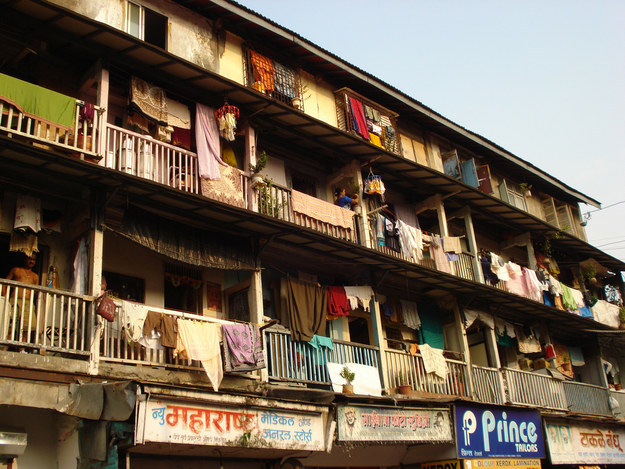
Telling of the fable of Mumbai is not complete without experiencing Mumbai’s chawls. A chawl is basically a 3-5 storied building with 10-20 rooms on each floor better known as kholis. Basically it’s as many rooms as the landlord can build as he gets rent per room. A kholi is a multi-purpose room serving for sleeping, storage, kitchen, and dining. Average rents run to about ₹1,000/month. Much like engineering college hostels, each floor of kholis share a common block of bathrooms. Kholis with private bathrooms are considered premium kholis and may cost about ₹1,500/month for rent. The common bathrooms are always filled with filth and at no time could you go there without queue, drunkards, and lechers hanging around them. And these are shared by both men and women. Each kholi is cramped up with 8-15 people on any given day. Many a times, individual kholis are divided into a front room and back room, with the front room rented out to another family.

I had been in Mumbai once before and in my limited experience during internships I’d seen from afar the chawls of Andheri (E) and Kurla. One thing I noticed was that they were all Muslims, leading me to believe that a majority of Muslim population in Mumbai is poor and lives in chawls; this came from the knowledge that an average Indian Muslim has a lower income and more mouths to feed than an average Hindu.

Such misconceptions broke as I lived longer in Mumbai. I realized something very deep and profound. Poverty had no religion. It affected everyone equally. There were chawls with concentrated pockets of Hindus, Muslims, Christians, etc. But there were chawls of all kinds. Poverty wasn’t correlated with a religion. It was correlated with the lack of money. Yet when I walked through these close-quartered chawls with little privacy, I saw how close communities could get when left uncared for. I saw chawls with Hindus, Musmils, Christians, Jains, and a Parsi family living in the same building having no disputes whatsoever, in an extremely harmonious and healthy manner. I saw Hindus working in tanneries and mosques built near temples. In my own “urban” dwelling in Calcutta, I could not imagine this.

Mumbai chawls reminded me of my own hostel from IIT KGP. Though to be honest, our rooms in the hostels were much smaller and had lesser amenities. The thing which striked me the most were the balconies which encouraged people to come out and interact with each other. Much like my Hall (not hostel) at Kharagpur, these ensured that people would come out, mingle, and create avenues in pursuit of common interests.

Dharavi, the world’s largest slum resides in the heart of the city. A few basic facts about this swirling vortex of entropy.


Dharavi
Mumbai
India
Dharavi (% of Mumbai)
Population
700k
19M
1.25 Bn
3.7%
Area
2 km2
1,300 km2
3.3M km2
0.2%
Economy
$500 M
$209 Bn
$1.9 Tn
0.2%
Population Density
350,000
people/km2
14,615
people/km2
382
people/km2

GDP per capita
$714
$11,000
$1,520

Land utilization
$250M/km2
$161M/km2
$576k/km2

Hindus
60%
67%
80%
3%
Muslims
33%
19%
14%
6%
Christians
6%
4%
2%
6%

90% of such chawls are illegally constructed. In lack of public utilities, the residents in these chawls face serious sanitary issues.  The water is often filled with roaches, centipedes, earthworms, and even the occasional scorpion which make their way inside houses. Clean water is available for 1-2 hrs/day which is filled in iron drums for everyday for the purposes of washing, cooking, and drinking. Even then it isn’t uncommon to find human and animal excrement mixed in the water, which people have gotten used to drinking anyway.

Something else you notice about these chawls is the struggle of survival. Resources and human life are so precious in these chawls that virtually any other form of life is wiped out – grass, flowers, plants, animals – nothing. The only animals that were left were wary and aggressive towards humans, knowing well the cruelty human beings are capable of inflicting.

I saw that generally, all the doors of the kholis were kept open at all times during the day. This was because the place could get very suffocating if kept closed. People from all walks of life live in the chawls, such as lawyers, accountants, gamblers, drug-peddlers, prostitutes, etc. There were clear marks of which blocks to go near and which not to, which was identified by which kholis the playing children avoided. Much like the hostels, people participated in social gatherings together and there was always someone in the neighborhood who’d let you know so you could come along.

Rampant disease and lack of hygiene are nothing uncommon in these chawls. Drunkards, mental disorders, rodents, violence, skin diseases, are generally accepted as a part and parcel of life.

Coming back, I did not feel pity. I did not know what I felt. On one hand, I was disgusted with the pathetic living conditions these people faced. On the other, I was inspired by the life these people found in whatever little they had. Today I take clean running water and dry walls as a part of life which I don’t even give a second thought to. To think that these might mean luxury for someone is hard to imagine. These chawls show the heights of both human kindness and cruelty. It’s tough to imagine and between those dazzling lights and fast cars there belongs another world, stricken with poverty and neglect. And whatever I do, they will continue to exist.