26 May, 2016

Lost Warmth

2 years had gone by, but the morning ritual had remained unchanged. Every morning, she would bring two cups of hot coffee to start his day. They had been through so much over those precious moments shared every morning. Fights settled, promises made, kisses shared, all with a sweet warm breath. She remembered how it had started… it was their honeymoon and she had woken up before him. Not wanting to wake him up, she decided to make some coffee for herself. He woke up from the sound of the pot and she offered the cup to him, which he accepted with a smile. That smile… she had never seen him smile like that in their year of courtship and she knew as long as he had that smile, there was nothing the two of them couldn’t go through. All she had to do was ensure he began every morning with the same smile, which he did till date. No words had ever been spoken. He had never asked. He had never needed to. The ritual had simply manifested itself.

She had come into his life hardly prepared for anything life would throw at her. Within a day, her life had turned around and she was not equipped to face it. Her mother had tried hard to instill some “household” manners in her, but she never bothered. As long as she could make Maggi and coffee, she could feed her husband, she used to think with a twinkle in her eye. Now she knew her words were true when in the middle of his sips he would sometimes silently come close to her and hold her in his arms, letting her know that her deficiencies didn’t matter to him. Sometimes, not often, he would allow small words of comfort to escape his lips.

The day of her miscarriage, he had brought her back from the hospital and simply laid her down on the bed without a word before going to sleep on the other end. The next morning, he woke her up with a cup of coffee for himself and a glass of warm water for her, taking her in his arms once again and telling her not to worry. Those were the only words she needed to hear. They had sounded so meaningless when the doctor had said them. Right now, they brought life back in her soul and she cried. Tears which had been held back then came rushing out now and he wiped every one of them. As long as he was there with her, no tear of hers would ever fall, she thought as she felt the taste of coffee on her lips. Coming back from the memory, she poured the bubbling liquid in two cups and made her way to their room.

As his bride walked in with coffee, he woke smiling… remembering the fragrance of his Aai’s coffee.

Vishal Gupta
October 2014


03 April, 2016

The Harbor Line 8/8 - Journey

A long time ago I’d read that every city has a word. For Rome it’s “SEX”, for Vatican it’s “POWER”, for New York its “ACHIEVE”, for Haridwar it’s “FAITH”. I have long wondered what the word for Mumbai is.

It’s “MOTION”. It’s easy to confuse Mumbai for a money hungry city with no soul. It’s difficult to think of Mumbai moving seeing hundreds of people idling about at the shores of the Arabian Sea after sunset on a weekend. But if you live here long enough, you realize that this city cares little for idle chats and somewhat lesser about money than what you’d expect. Mumbai earns, but Mumbai spends.

I come from a Maadu city where people hold the opinion that any expense should transform into an investment. Otherwise it is a waste of money. Mumbai doesn’t care. People here want to see their money move, even if it doesn’t grow. Maybe it’s the stress which is inherently built into Mumbai’s lifestyle. If that can be alleviated on a weekend by watching a play for 3,000 bucks, why not? But you need to keep moving.

I think it comes from to each Mumbaikar by design of the city. For no one grows up in Mumbai without being pushed inside a crowded train. No one ever thinks twice about taking up a job 3 hours away from home and spending a quarter of their day in travel. Being raised in such an environment, you get tuned to keep moving. You become impatient like the crowd. And life becomes a constant struggle to move ahead.

In many ways these trains represent everything Mumbai is about. A class divide. Crowd. Motion. Structure. Trade. Struggle. Friendship. Fear. Courage. And most importantly, movement. Moving on.

I remember the other day in the train I was engrossed in my Kindle that I completely forgot that the station had arrived. Not that it mattered. It was the last station and an emptying train would surely catch my attention. As I realized the station had come I packed my Kindle in my bag and started getting down when I heard the words, “Who’s bag is this? Get down fast!” Apparently someone had forgotten their bag in the overhead compartment and gotten off the train. Now in most parts of the world this would be a sight ignored. Or perhaps a good seminarian would take the bag to the lost and found section on the station. But for Mumbai, this was terror. At first I did not understand why people were running out of the train in sheer terror at the sight of the bag. It was a harmless bag. But more I thought about it more I realized that trains were a vulnerable point in Mumbai’s security. With a hostile neighbor attached to Mumbai by the sea, Mumbai had been a victim of repeated terror strikes in the past. Even though the last one had been 8 years ago, the memory of a 21 year old boy with a machine gun in one hand, and blue bag slinging on the other, on this very train station was still etched clearly in the memory of these people. It was a morning pretty much like that one. The station must have been as crowded as it was that day. And the people would have had been as unsuspecting. Proceeding to begin another day of firefighting with their jobs. Little did they know that it would be the last day of their lives. Mumbai remembered this. But Mumbai moved on. This city does not stop for anything. Not the wrath of Gods or men. Because that is what Mumbai is about. Moving on.

As time moves on, so does Mumbai. It is not a very old city. In fact till 1845, geographically it didn’t even exist as a single landmass but only as a collection of islands. Maybe that’s the reason the sea could never truly leave its hold on Mumbai and sends showers every year to try and reclaim its lost child. In the short span this city has been in existence, it has grown to account for nearly 10% of the country’s GDP. Most people would agree that this is an amazing feat and Mumbai is the most developed city in India. Others are obviously Delhites.

Still, as the Harbour Line moves down Central Mumbai, one cannot help but notice the heaps of garbage alongside the train tracks. To an amateur economist like me, dumps of plastic are also an indication of a flourishing economy, but one can’t help but wonder if the cost of such development is worth it. Those who are responsible for the mess are seldom affected by it, leaving the poor to grapple with the problems. An interesting thought came to my mind when I visited one of the many flourishing offices in Lower Parel, as shown in the picture below. There were air-conditioners on almost every window, and no single window was open. It wasn’t summer time in Mumbai, and I daresay the wind was pleasantly cool. Yet it didn’t seem as if those windows had been opened in a very long time, nor did anyone seem to be interested in such an ordeal. Closed boxes of offices with temperature regulation have become the norm and when something of this scale happens in a city like Mumbai, it cedes to become the action of a single individual. It then becomes what is known as an institutional phenomena, i.e. it’d be foolhardy of me to even recommend a solution like “turning off the AC and opening the windows” to any of my peers. Institutional problems are to be solved by institutional solutions.

But when did this ever become a problem? Was I too hasty in my judgment to claim it as one? No one seems to be really bothered by the air-conditioners running all the time. In fact, they welcome it. After all, one does need respite from the Mumbai heat. As the ocean proceeds to engulf the city once again, we happily seat ourselves in leather chairs and cool offices, never to mind what happens outside.

This makes me think, in our pursuit of development, are we proceeding towards our fall? The internet was invented to save time, yet it has allowed time to enslave us beyond the normal hours of any work. Air conditioners were invented to keep us cool, and now we’ve reached a point where they have become a bane for the planet’s atmosphere. Cars were invented to quicken and ease the journey, but one cannot drive in Mumbai without being stuck in dreaded traffic jams and shifting between the accelerator and the break. Our lives have continually progressed towards more and more complexity. Stress is at an all-time high. We strive to buy houses which we never have time to live in. We wish to buy things we don’t need to impress people we don’t like with money we don’t have. Everything the wise had predicted once has come true. We never realize when the hands change the strokes on a piano to strokes on an excel sheet. And life goes on… As comfortably and predictably and you may imagine.

Yet, when the night falls, sooner or later it always does, and when it falls, leaving starry skies and quiet souls, the heart yearns for what it was born for. It yearns for the peace it has long left behind. Behind the tears of remembrance one dreams of enjoying the tranquil moments of serenity it was born for. And as the clouds approach you from the ocean near Marine Drive, a child beggar-performer begins to sing,

24 March, 2016

The Harbor Line 7/8 - Mumbai Chawls


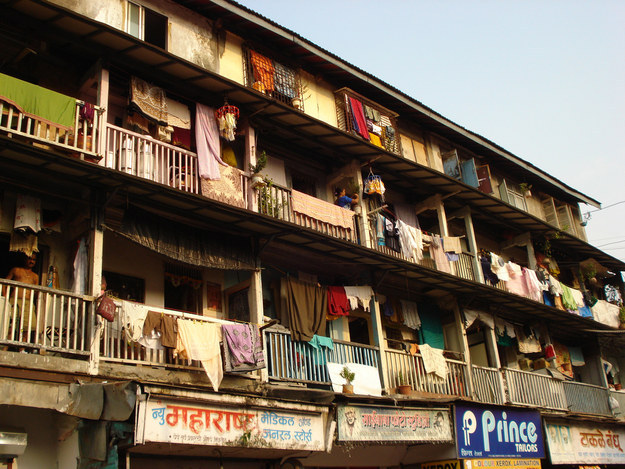
Telling of the fable of Mumbai is not complete without experiencing Mumbai’s chawls. A chawl is basically a 3-5 storied building with 10-20 rooms on each floor better known as kholis. Basically it’s as many rooms as the landlord can build as he gets rent per room. A kholi is a multi-purpose room serving for sleeping, storage, kitchen, and dining. Average rents run to about ₹1,000/month. Much like engineering college hostels, each floor of kholis share a common block of bathrooms. Kholis with private bathrooms are considered premium kholis and may cost about ₹1,500/month for rent. The common bathrooms are always filled with filth and at no time could you go there without queue, drunkards, and lechers hanging around them. And these are shared by both men and women. Each kholi is cramped up with 8-15 people on any given day. Many a times, individual kholis are divided into a front room and back room, with the front room rented out to another family.

I had been in Mumbai once before and in my limited experience during internships I’d seen from afar the chawls of Andheri (E) and Kurla. One thing I noticed was that they were all Muslims, leading me to believe that a majority of Muslim population in Mumbai is poor and lives in chawls; this came from the knowledge that an average Indian Muslim has a lower income and more mouths to feed than an average Hindu.

Such misconceptions broke as I lived longer in Mumbai. I realized something very deep and profound. Poverty had no religion. It affected everyone equally. There were chawls with concentrated pockets of Hindus, Muslims, Christians, etc. But there were chawls of all kinds. Poverty wasn’t correlated with a religion. It was correlated with the lack of money. Yet when I walked through these close-quartered chawls with little privacy, I saw how close communities could get when left uncared for. I saw chawls with Hindus, Musmils, Christians, Jains, and a Parsi family living in the same building having no disputes whatsoever, in an extremely harmonious and healthy manner. I saw Hindus working in tanneries and mosques built near temples. In my own “urban” dwelling in Calcutta, I could not imagine this.

Mumbai chawls reminded me of my own hostel from IIT KGP. Though to be honest, our rooms in the hostels were much smaller and had lesser amenities. The thing which striked me the most were the balconies which encouraged people to come out and interact with each other. Much like my Hall (not hostel) at Kharagpur, these ensured that people would come out, mingle, and create avenues in pursuit of common interests.

Dharavi, the world’s largest slum resides in the heart of the city. A few basic facts about this swirling vortex of entropy.


Dharavi
Mumbai
India
Dharavi (% of Mumbai)
Population
700k
19M
1.25 Bn
3.7%
Area
2 km2
1,300 km2
3.3M km2
0.2%
Economy
$500 M
$209 Bn
$1.9 Tn
0.2%
Population Density
350,000
people/km2
14,615
people/km2
382
people/km2

GDP per capita
$714
$11,000
$1,520

Land utilization
$250M/km2
$161M/km2
$576k/km2

Hindus
60%
67%
80%
3%
Muslims
33%
19%
14%
6%
Christians
6%
4%
2%
6%

90% of such chawls are illegally constructed. In lack of public utilities, the residents in these chawls face serious sanitary issues.  The water is often filled with roaches, centipedes, earthworms, and even the occasional scorpion which make their way inside houses. Clean water is available for 1-2 hrs/day which is filled in iron drums for everyday for the purposes of washing, cooking, and drinking. Even then it isn’t uncommon to find human and animal excrement mixed in the water, which people have gotten used to drinking anyway.

Something else you notice about these chawls is the struggle of survival. Resources and human life are so precious in these chawls that virtually any other form of life is wiped out – grass, flowers, plants, animals – nothing. The only animals that were left were wary and aggressive towards humans, knowing well the cruelty human beings are capable of inflicting.

I saw that generally, all the doors of the kholis were kept open at all times during the day. This was because the place could get very suffocating if kept closed. People from all walks of life live in the chawls, such as lawyers, accountants, gamblers, drug-peddlers, prostitutes, etc. There were clear marks of which blocks to go near and which not to, which was identified by which kholis the playing children avoided. Much like the hostels, people participated in social gatherings together and there was always someone in the neighborhood who’d let you know so you could come along.

Rampant disease and lack of hygiene are nothing uncommon in these chawls. Drunkards, mental disorders, rodents, violence, skin diseases, are generally accepted as a part and parcel of life.

Coming back, I did not feel pity. I did not know what I felt. On one hand, I was disgusted with the pathetic living conditions these people faced. On the other, I was inspired by the life these people found in whatever little they had. Today I take clean running water and dry walls as a part of life which I don’t even give a second thought to. To think that these might mean luxury for someone is hard to imagine. These chawls show the heights of both human kindness and cruelty. It’s tough to imagine and between those dazzling lights and fast cars there belongs another world, stricken with poverty and neglect. And whatever I do, they will continue to exist.

14 March, 2016

The Harbor Line 6/8 - Bandstand

Mumbai is a cannibal of a city, slowly devouring the suburbs around it. I live at the humble township of Kamothe across Thane creek. But every now and then, the ocean calls me. It was a Saturday night with college friends in a lounge at Powai. As old friends meet and one thing leads to another, we soon found ourselves staring at the strong waves rushing to our feet at Bandra’s famous bandstand. The wind howled calling us to run with it and the slippery rocks were the sole mark of safety the rocky beach could provide. In many ways, this one place represented everything this city of dreams stood for. The vast unending ocean, I knew at the back of my mind that the ocean really did have an end. And that it was a small planet my specie had inherited the habitation of. Yet eyes deceived the knowledge when the ocean turned beyond the horizon and left for faraway shores, or perhaps a journey without a destination. Despite its vastness, the ocean was humble enough to continue rushing towards me and washing my feet with all its might. Sometimes I felt that I’d come too far and the waves would sweep me along. It was easy to forget myself in those waves, and become a part of them. A part of my heart did ask me to take bold steps forward. But I knew that it wasn’t my destiny to become a part of the waves. I came with a dream to rule the waves. The least I’d do was take back lessons from them. Yes there were those who made the waves parts of their lives. But I had to go back. I am a boy of the shore, at least till the waves do not make me one of their own.

That’s all it took. A few bold steps, a bit of courage, some thought, and some talent; the waves would come forth to kiss my feet. But I had to be careful. I was the only one who could decide what I wanted. Whether I wanted the waves to kiss my feet, my lips, or my soul. The deceitful waves were ever-eager to make use of one mistake of mine, and they’d claim me. That’s all it took, one mistake, one folly, one moment of disregard and the ocean would consume you. To stand your own among the waves needed unflinching determination and discipline. Yet it was so tempting and easy to just let go and join the vastness.

I did not come back without any bruises. There was one, received very quickly. Too eager and young I was to go towards the waves and immediately they gifted me with a wound that pains till date. It serves a reminder to what eagerness may do. In a crowd of millions, there would be more eager to come forward than those who would take the time to appreciate the careful steps it took to come forth. My first folly was my last. The scars would serve as a constant memory of the innocence I had, and how the ocean showed me its worth.

I realized that the farther I went, the stronger my waves would become till the point I had no option but to let my friends catch up. Holding each other, we’d be able to cross the creeks. For that we had to let go of everything else in our grasp and just hold on to each other. Some said it was absurd to attempt. Some wouldn’t let go of their dear possessions. Only a few who understood that only holding one-another would we be able to cross did choose themselves for the task. Thankfully, the people with me were the exact kind. Together we stood as far as the shores and our feet would allow us without the dangers of drowning. Each one of us held everyone else and everyone ensured that we’d hold our own.

I looked at their faces. Most of us had come from smaller towns, such as ones which Mumbai wouldn’t even consider to cannibalize. Our oceans didn’t pour like Mumbai’s do. They gave barren sunshine and scarce rain. No creeks or rivers to mark our lands and no vast oceans to kiss our feet. Perhaps that was what brought us here, together. To realize the big dreams we’d seen together. Together, we shouted in euphoria! We screamed at the sky to let us taste the clouds and let us etch our names across the stars with our sweat. We asked the moonlight to show us the paths to our glory. We looked up at the stars, wondering if we’d live our lives differently if we saw them every night. Why didn’t we? Maybe because the ceiling came in the way every night. The ceiling which we’d worked for the past week. But was it worth it?

06 March, 2016

The Harbor Line 5/8 - Mumbai Trains


The second class train tickets on Mumbai trains are much like the front seats of a movie theatre. That’s where all the action is. That’s where all the people are. And if you wanted to enjoy the movie sitting in peace, or maybe even take a nap in the AC, you clearly made a mistake.

With the office at the coveted Fort near Mumbai CST and bathing-sleeping quarters at Kamothe near Mansarovar, I am condemned to spend 3 hours of train travel back-and-forth everyday via the Harbor llne. There is no dearth of humankind anywhere close to a train station in Mumbai. The train, including the ridiculously expensive 1st class compartments, is full by the time the train reaches its 3rd station, merely 6km away from its source, at Mansarovar. To avoid a long standing journey which would inevitably burden me with my own obesity (which I still blame on my US trip a year ago), I devised a diabolical plan to take a seat from the stupid Mumbaikars. After all, these Marathi Manoos can't be cunning like Maadus, known to thrive on the basis of their cunning. So I decided to take the train back to Panvel in the morning, and then go from Panvel to CST. Since no one goes to Panvel in the morning (I don't know why anyone would go to Panvel at any time during the day), an empty seat was guaranteed and I'd be the king of the 1st class with my window seat!


No great plan, no matter however Maadu it may be, is ever perfect. That's what we have learnt from the great Joseph Stalin. May his soul wreak havoc in hell. As I boarded the train, it didn't seem empty enough. While there were plenty of empty seats, my vision of dancing in an isolated 1st class train compartment in the morning everyday didn't seem viable anymore. As the train crossed Khandeshwar, the crowd seemed to add up with only a few empty seats. Somehow I wasn't the only clever guy in Mumbai. There were simply too many Maadus here, I concluded.

There was another hitch in my plan. The trains from Panvel don't necessarily go south to CST. They may even go north to Thane. And while I don't mind seeing the place where the Arabian Sea rushes into the Indianmainland, I really didn't want to add ANOTHER hour to my journey. So I was obliged to deploy the entire summation of the analytical, theoretical, archeological, and rhetorical skills I learnt at XLRI (#MBAswag). I carefully drew out the list of all the trains going from Mansarovar to Panvel, from Panvel to CST, from Panvel to Thane, and just in case I need it some day, from Mumbai to Bhutan.

I usually take the 1st class for my journey, but one day I decided to rub shoulders with the poor folk. Why? Well the 1st class didn't really feel like the 1st class. There was no AC, no guarantee of getting a seat, and time and again, I found myself starting into the ass of some guy standing right in front of me. I wanted to know how much worse it could get.

The first thing I noticed about the 2nd class was that not too many people took the back-and-forth coming around approach that I took. People in the 2nd class generally took the train in the direction where they wanted to go. Maybe the mindset being a 2nd class passenger doesn't allow you the luxury of even wishing for a seat. Or maybe the time of the passengers in the 2nd class was more valuable than the time of those in the 1st. Or maybe there weren't enough Maadus here.

One thing which scares the weak-hearted such as myself when a local arrives, is the sight of the men hanging by the doors of the train. One slip, and a life could be in peril. Many have and do perish riding in these overflowing trains. But those are elephant teeth honestly, there’s always space inside the train. As once said by my wise boss before he sent me to battle the excel sheets on my computer, “there are 3 things which never fill completely, Mumbai trains, broken hearts, and our coffers.” People just like to hang by the doors, and most are very good at it too. And this leaves the inwards of these trains relatively emptier than what they look like. If I was a LOTR fan (oh wait, I am!), I’d have believed it to be a long planned scheme of Mumbaikars trying to elude people into thinking that this compartment is full, so that the folks may look elsewhere in the train to get in.

Or maybe they just like the breeze the fast-train provides going through their hair. I don’t know. I’m new here.

Apart from that there was little difference I noticed. The windows seemed to be smaller but I decided that was my mind playing tricks on me trying to justify the 10x expense I'd gotten used to paying. The seats were also harder and less butt-friendly. Seldom, there would be 4 guys on a seat, though my size disallowed any 4th person on the seat I was on. The seats also "looked" dirtier than those in the 1st class, but were actually very old blotch marks. The crowd was practically the same. There was still some guy's ass in my face, and the train was as crowded. After all, there's only a limit to the crowd. After all, you can't expect to add anything to infinity and expect it to change. It's like Hilbert’s Grand Hotel. The number of people on the train doesn't change.

On one such long trips, I was especially sweating and trying to find the location of my hand. I thought of flexing my fingers to feel if they were still attached to the rest of me, but the thought of probably brushing someone inappropriately with them put me off it. As a semi-Hindu, I put my faith in the God of trains. We have Gods for everything and once we had Gods for horses who fathered Nakul and Sahdev. Perhaps they or their descendants were later made Gods of vehicles with a lesser branch given the responsibility for Mumbai local trains. They were treated as 2nd class Gods anyway.

Anyway, I put my hope in that God and hoped my hands would be intact when I would be pushed out of the train. We never go out or come in willingly. As with Mumbaikars and the city itself, the passengers in local trains simply, “go with the flow.” I’m usually not the one to complain about the crowd in trains, but on that fateful day I happened to blurt out to the guy who was looking at me (because that was the only space his twisted neck allowed him to look at), ‘It’s pretty crowded today.’


The half-face with 2 eyes, one nostril, a mouth, and an arm coming out of under the chin looked at me, as if looking at an alien and replied, ‘yes. It used to be better 20 years ago.’