03 September, 2017

Collectivization In The Indian IT Sector

The Indian IT Industry exists in a country obsessed with socialism and plagued with policy paralysis. In such a scenario, collectivization of the industry takes into account the present unions, diversity existing across the industry and merits of collectivization itself.

INTRODUCTION

Collectivization as a concept came into being between 1890-95. Collectivization essentially means the organization of an economy, industry or enterprise by forming collective communities where property and resources are owned by the community and not individuals.[i] Most famously, collectivization was a policy adopted in erstwhile Soviet Union under Joseph Stalin between 1928-40 where peasant farms were replaced by collective ones to increase food supply. This was seen as a solution to the agricultural distribution crisis faced by them since 1927.[ii]

The Indian IT Industry is highly decentralized in in terms of geographical distribution as well as the profile of work. Thus far, the National Association of Software and Services Companies (NASSCOM) is the largest organization association in the industry.

Industry overview

The Information Technology Industry in India primarily consists of two broad horizons – IT Services and Business Process Outsourcing. Other areas such as Software, ER&D and Hardware also account for a fraction of the industry. The industry has seen a robust revenue growth in both domestic and international markets. Between FY 1998-2012, the share of the IT sector in total Indian exports increased from less than 4% to about 25%.[iii] The booming industry with its vast export market also contributed strengthening ties with both the USA and the EU.

The IT-BPO industry is a net employment generator. In FY2012, the industry added 230k jobs totaling to a direct employment to about 2.8m while indirectly employing 8.9m people.[iv]

The Indian IT sector currently specializes in providing low-cost business solutions. Only a few companies have the competency to take up projects involving high end SLDC (Software Development Life Cycle) processes such as requirement analysis, architectural design and product development. However, there has been a slow upward trend in this direction. A problem which the industry faces is the lethargic attitude of the government in providing a telecommunication infrastructure which slows growth.[v]


The landscape of the Indian IT industry is marked with the coexistence of two diverging yet prominent features – diversity and concentration of power. NASSCOM figures show that there are over 1.3k start-up firms in the IT sector, primarily in e-Commerce, Education and Internet services. The industry itself comprises of over 16k companies. However, more than 40% of the revenue generated is attributed to the top 11 players while an odd 15k companies are able to attract only 9-10% of the revenues. Moreover, the industry draws a major chunk of the working population equipped with many different skill-sets and educational qualifications. It is in the background of this concentration and diversity, we address the issue of collectivization in the sector.

Nasscom

The NASSCOM is a non-profit trade association of the Indian IT industry and allied sectors registered under the Indian Societies Act, 1860 with its headquarters at New Delhi. Among its 1,500 members, about 17% are companies from the US, EU, Japan and China. The companies registered with NASSCOM represent 95% of the industry revenues and have commanded ingenuities to shape the industry in India as well as globally.[vi]

NASSCOM plays a role in the enforcement of Intellectual Property Rights in the Indian Software and BPO industry. The organization also provides a mentorship programme for mid-sized companies, i.e. a 6-month engagement which helps organizations to develop a better assessment of their strengths and weaknesses. The members can participate in opportunities for global networking and build business at NASSCOM's global events, and through delegations and road shows.

CURRENT STATUS

The IT Industry has a framework in place for advisory, technology growth and networking initiatives. However, there are no frameworks in place to pool resources or revenues for the sector. Cooperative solutions to address key industrial challenges are encouraged to drive industry growth. Furthermore, 8 councils consisting of Directors, CEOs and senior Executives of major IT companies tailor to the requirements of sundry sections of the industry and aim to create detailed programs which may assist these sections to realize the opportunities and share the best practices. These councils act as advisory groups to the industry members for modelling the programme on a regular basis and take control on particular ingenuities. They also hold an annual product conclave showcasing innovative product companies. The advisory groups have been formed for the following sectors:

In addition to this, 6 Regional Councils have also been formulated to function across different cities. The aim of these councils is to construct strategies, address indigenous disputes, allow intra-industry networks and share best practices. Moreover, these Regional Councils also contribute towards the development of the industry in tier-2 cities where the industry has significant presence but has strong growth potential namely Coimbatore, Indore, Kochi, etc. Another motive of forming these Regional Councils is to lobby with local governments for policy advocacy.[vii] 

10,000 Start-ups Initiative

One of the most interesting and exciting developments in the IT industry in recent times has been the advent of a large number of entrepreneurial innovative companies in the space of IT driven by young entrepreneurs bubbling with new ideas. The 10,000 start-ups programme is an early stage incubation program NASSCOM has put together to help faster growth of the entrepreneurial ecosystem in India. Entrepreneurs who have ideas are often desperate searching for someone who can guide them on issues like how to run a start-up, how to grow a business, etc. The initiative is partnered by large enterprises like Google, Microsoft, Kotak, etc. aims to make the bright young talent of the country look for more than just their next job. Entrepreneurs are given an opportunity to meet with mentors, potential investors, and fellow entrepreneurs.

A start-up warehouse programme identifies some of the best start-ups and provides mentorship, space, customer connects, etc. Some of the start-ups participating in the programme have been able to connect with large platform players like Intel, Google, Microsoft; some of the largest retailers in the world – Walmart, Tesco, Target, etc.

At a very early stage a start-up requires capital and connections which is exactly what is provided. Entrepreneurs gain exposure by talking to investors in accelerator programmes. Selection by such programmes gives a lot of validation to the product-concept. The power is shifted from the investors and accelerators towards the entrepreneurs. Initially the focus was only on creating a database of start-ups but has evolved since. Awareness around the massive set of opportunities that existed for entrepreneurs in India to build technology start-ups was increased. The platform primarily provides support for funding, acceleration, mentoring, enterprise connections, recruitment support and prototype development.

A lot of knowledge and initiatives is driven in the deep-hearted start-up communities of tier-2 and 3 cities which are hitherto unknown to the ecosystem outside.

A momentum has already been build which is continuing. Now the initiative looks to address some constraints which are emerging. A number of policy inputs based on the funding requirements, regulatory issues, infrastructural support, etc. which have emerged through this process allow for policy inputs to the government so that government policies are also supportive of this ecosystem.

In its first 9 months, the programme has impacted over 200 start-ups directly and touched over 25k entrepreneurs.[viii]

Policy advocacy

In 2013, the IT industry as a whole was able to work with the Government of India to change and release Safe Harbor Rules which lays out amendments in taxation policies, SEZ rules in tier-2 cities, service tax refunds, etc.

In recent times, the Judiciary and tax department have been burdened with accumulating litigations and cases. As per new norms, Government would notify the tax norms relating to the industry which would help attract new investment from previously concerned MNCs, expansion of existing centers and offer certainty. The rules are to be applicable for 5 assessment years beginning from 2013-14.[ix]

In the realm of Global Trade Development, the US Immigration Bill when came into place was seen as discriminatory and detrimental to the Indian IT Industry. The bill tabled immigration reforms addressing America’s problems. This challenged the influence of the Indian IT industry on the US economy in terms of taxes and social security, creating employment, and renovating companies by making them more competitive.


Moreover, the unemployment in the IT sector in the US was 2.2% in 2013 Q1[x] while the headline unemployment rate stood at 7.6%.[xi] Further restricting immigration would only add to the existing problem of finding talent in the sector making it difficult for all organizations to hire locally. Another finding by the National Foundation for American Policy states that the top 25 India-based companies utilized 20% of the H-1B visa approved for initial employment in FY2012 representing only 0.017% of the US labor force.[xii]

These issues were raised with the Indian Government. Subsequently, the Finance Minister, Commerce Minister, and the Minister of External Affairs raised these concerns with US authorities. In addition to this, NASSCOM connected with international firms, associations and others on expressing the influence of these deleterious provisions on the US industry and the trade relations among the two nations. The Global Trade initiative also deepened its emphasis on building new market prospects in emergent markets such as Japan, China and Africa.

Skill Identification

Regularly, IT-ITeS Industry Occupational Analysis Reports are released which ascertain unique professional roles in the industry for entry, middle and leadership levels. Enactment of these standards aid in better defining of skills and proficiencies for the industry. The reports intend to normalize and simplify the practice for employing and training talent and will assist the sector to shape rightly-skilled, high class, job-ready and employable manpower.

The four sub-sectors included in the Occupational Analysis are IT Services, Business Process Management, Engineering and R&D & Software Products and 67 unique entry-level job roles have been acknowledged in the purview. The reports concerning knowledge, abilities and conducts, vital for performance in a specific occupation have been recognized in the analysis.

“India is at the cusp of a great opportunity and is entering an era of becoming the workhorse for the world. Reports like these are the first steps towards creating an understanding for the skills and behaviors required for the IT-BPM industry. The Government of India has set a target of skilling 500 million people by 2022; to be able to deliver this target, a structured approach involving all stakeholders is imperative. This is a starting point in the direction of imparting skills for the relevant jobs. These reports give us a clear understanding of the opportunities of the industry.”

-          Mr Shashi Tharoor, erstwhile MHRD, GOI[xiii]

The Indian IT-BPM Industry currently employs about 3M people directly and about 9M indirectly. The Industry holds a potential to provide 30M employment opportunities by 2020. Training professionals in the identified courses may lead upto 60% increase in employability. The Government of India has set a goal of skilling 500M people by 2022. To be able to achieve this a planned method linking all stakeholders is vital.

CONCLUSIONS

In an era of policy paralysis and upcoming start-ups, collectivization of knowledge and networks does produce a faster growth curve. It speeds up the learning curve of new entrants in the arena for both individuals and corporations. However, pooling of resources might do more harm than good. One of the major competencies of the Indian IT sector is its cost-effectiveness which is guided by the violent competition within the industry. Other Asian nations having abundant cheap labor do not enjoy this thrill of in-competition which contributes to the growth of the industry.

Diversity

As already seen, the Indian IT industry is vastly diverse in terms of geography, size of operations and verticals of competency. While they make collectivization difficult, they also provide specialization in various fields the constantly evolving industry demands. Collectivization also entails scientific management where one correct way of doing things is found. However, the industry continues to grow and evolve in unchartered areas in the beginning of the 21st century making it very difficult to have a stringent procedure. Collectivization may kill the creativity which is a prime feature of this industry.

Even the new players in the field do not define the one growing vertical of the industry. The two leading areas continue to be education and ecommerce which themselves create space for further concentrations. Even the largest exporting sector, i.e. IT services accounts for only 30% of the total exports creating a vast space for other areas such as BFSI, healthcare, utilities, etc.

Even the revenues of the industry have shown stark imbalance where 40% of the returns are enjoyed by the big 11 firms while 1.5k firms share 10% of the proceedings. In such a scenario, collectivization is sure to kill off the small growing players. This has two adverse consequences. One, it kills the entrepreneurial spirit which has been industriously nurtured in the country. Two, it would cause people falling out from one of the biggest employing industries for young educated Indians.

All successful IT companies in India share a culture of a healthy hierarchy and manageable size. It has been seen that companies usher their own doom by becoming too big to manage. In the absence of strong resource databases and knowledge-sharing systems, the industry might face similar consequences on collectivization. Already, the industry faces a management to employee ratio of 1:25 while the recommended average of a large industry is 1:40. The reason why the industry is able to sustain this number is due to the small size of organizations and high number of start-ups where management and employee roles are mixed. As of now, the Human Resource Capital of the industry in India does not allow for efficient collectivization.

Collectivized Rights

Collectivization poses the problem of Collectivized Rights. In a collectivized industry the system is ruled by the requirements of the leader, i.e. the majority gang leaving no space for minority interests. Just because the collectivized industry chooses to pursue a certain product or service, does not mean it is the right or required thing to do. Collectivized rights put too much might with the leader which poses the risk of destroying the industry at once.
                       
Collectives need to take into account the needs of all individual participants. The collectivized rights need to be derived from the rights of its members through voluntary, individual choice and contractual agreement. Every legitimate group undertaking should be based on the participants’ right of free association and free trade. Forcing participation would not count as legitimate collectivization. As we have seen, the IT industry is extremely concentrated in power making it easy to forecast the power balance in a state of collectivization.

Currently the IT industry enjoys the right of engaging or not engaging in businesses which is derived from the right of the owners to invest their money in a productive venture, the right of a firm to hire employees, the right of the employees to sell their services, the rights of producers to produce and sell their products and the right of the customers to choose and buy those products. Every link of this chain of contractual relationships rests on individual rights, choices and agreements. The notion of collectivization in the IT sector would leave these rights to some firms and take them away from others, which would rest on the power of lobbying.

Collectivization takes away the freedom the IT industry currently enjoys. There need to be some norms which help avoid criminal activities, i.e. violating the rights of others, but collectivization may lead to an industry where small players become pawns in a bigger game. The law must not give anyone the right to this. IT would not matter whether the smaller players are bullied by force or voting, the fact would remain that they would lose their rights. Again, it is not the duty of the big companies to nurture the younger players at their expense. This cannot be done until some vested interests are first taken account of. The big firms must only help the smaller ones if and when they choose to do so. Even in a state of collectivization, the leaders must have no right to violate the rights of the smaller firms.[xiv]

Benefits of Collectivization

It is difficult not to see the benefits of Collectivization in the Indian IT industry. It is easily seen that the growth of the IT industry follows the growth of NASSCOM. It also helps in identifying talent and training them according to broad industry needs while growing the industry itself in important sectors. Infact, some prefer collectivized decisions which protect the smaller firms from eradication as opposed to a capitalist environment which makes it impossible for start-ups to survive. Collectivization also assures obligatory employment. Most professionals are unable to find employment in the fiercely competitive market. Collectivization ensures the industry as a whole taking care of everyone where the needy would be supported by those with means. In a country like India where unemployment increases year-on-year, collectivization in one of the fastest growing industries may help to curb this problem to a large extent. The workers face constant exploitation and low salaries. In recessive cycles, layoffs are seen as an easy way of cost-cutting. Such problems would not exist in a collectivized industry. Some argue that collectivized industries leave little to wish for the workers and they are able to focus better or the work rather than other aspects of their lives.
                              
Moreover, larger resources such as bandwidth and allied infrastructure can be more efficiently provided by the Government equitably through collectivization. Experts could help the industry to grow in modern ways resulting in better quality and quantity of products and services. It would also become much easier to procure resources. There would be fewer supply points in the industry. Also, collectivization aligns itself with the goals of the Indian Republic, i.e. to be a socialist state. There cannot be a socialist state where the majority of firms are private who can sell their products on the market. Collectivization would socialize the industry raising the overall standard of living.

Demerits of Collectivization

It has repeatedly been argued that collectivization would lead to the death of the Indian IT industry by convergence of the industry diverging from the present dynamic model. It can easily be seen that a collectivized industry will fail to cater to the needs of niche markets which might grow over time. Moreover, collectivization would lead to lower labor requirements releasing unemployed populace in an already struggling economy. The bureaucracy in such a condition would move ferociously fast in a mad competition to see who could get most firms into collectives. The Government, which lays the laws, would have little control over the happenings in the districts. Over the course of history, it has been invariably seen that collectivization leads to a rise in prices, later liberalization, tax reduction and advance cash payments to incentivize production for niche markets. However, this charade leaves the industry crippled and incompetent against international players and with a huge labor force. Ironically, international competitiveness is what the Indian IT industry is known for. Small private firms grow in size and provide for much of the production of the industry. With IT guiding the economy of India to a large extent in the present day, we would not like to risk the entire economy of India by collectivizing such a key industry.

Impact on Entrepreneurs

In a collectivized industry, most enterprising professionals cannot survive. Most new small firms would be shut down in such a scenario. Entrepreneurs who wish for their own profits would resist working for a collective. Also, it is difficult to place trust in to what extent would their resources be collectivized, refraining small players to share their knowledge to the market. Once profits have been made, entrepreneurs would find it difficult to fight the larger collective to preserve their fair share and have to pay a terrible price for their resistance and lack of cooperation.

Another problem is lack of incentive. The entrepreneurs have nothing to work for. The profits generated by collectives cannot assure anything left for them. In this environment, apathy, neglect and petty insubordination grows. No manager can perform with such employees at hand.

FINAL WORDS

The study shows a mixed picture. While Collectivization looks like a good measure to standardize and grow the industry in a state of policy paralysis and low domestic revenues, the human costs may turn out to be horrendous. It comes down to a choice which the economy has to make whether to be dominated by the private market or be at the mercy of a few large players.


REFERENCES

[i] Collectivization. Dictionary.com.

[ii] McCauley, Martin, Stalin and Stalinism, p.25, Longman Group, England, ISBN 0-582-27658-6.

[iii] Gartner Says Top Five Indian IT Services Providers Grew 23.8 Percent In 2011. Gartner. Mumbai, India. 7 May 2012.

[iv] India IT-BPM Overview. NASSCOM. December 2012.

[v] MohanRaj, Prasanna; Niranjan and Snighdha. "Indian I.T Industry - A Model based approach to a shift towards a Prominent Presence in the Global Market". Research Journal of Economics and Business studies. May 2014.

[vi] "Vision and Mission". NASSCOM. Retrieved 2012-01-13.

[vii] Councils. NASSCOM.

[viii] NASSCOM 10,000 Startups Celebrates One Year. 10,000 Start-ups - a NASSCOM initiative.

[ix] SAFE HARBOUR RULES FINALIZED AFTER CONSIDERING COMMENTS OF VARIOUS STAKE HOLDERS. PRESS INFORMATION BUREAU. GOVERNMENT OF INDIA. New Delhi: September 18, 2013.

[x] Tech Employment Snapshot. Dice.

[xi] Labor Force Statistics from the Current Population Survey. Bureau of Labor Statistics. June 28, 2014.

[xii] Indian techies creating jobs in US: Study. Press Trust of India, 3 May 2013.

[xiii] Aimed at standardizing the process for hiring and training talent. 11/14/13. RSSING.COM

[xiv] Collectivized Rights. The Virtue of Selfishness. Ayn Rand. June 1963.

03 August, 2017

A Study On Bio-Degradable Plastics

Since their creation, plastics have revolutionized the world. Being easily moldable and the ability to transform into any shape of any size, plastics have found uses in a wide application of household as well as commercial uses replacing glass, wood, steel. However, unlike conventional materials, plastics are immune to bio-degradation: a process where products are transformed into lesser compounds by bacteria in the soil. Some plastics may be able to break down plastics, however, it remains a remote and expensive method. The only real way to decompose plastics is by UV-radiation which breaks the bonds in the long molecular chain breaking down plastic into lots of little pieces. However, plastic buried in landfills rarely see light of day. Plastics dumped in the ocean are exposed to light, and do degrade in as less as an year. Yet, the resulting small bits of plastic end up in sea-animals and shorelines in toxic form. The solution proposed is biodegradable plastic. Currently, there are 2 types of of biodegradable plastics on the market –
  1. Plant-based hydro-biodegradable plastic
  2. Petroleum-based oxo-biodegradable plastic
In the Plant-based hydro-biodegradable plastic category, polylactic acid (PLA), a plastic made from corn, is the most popular alternative. In perfect conditions PLA is decomposable in water and carbon-dioxide in 47-90 days, i.e. 25% of the time taken by PET-based plastics.

These alternatives are collectively known as bioplastics, deriving their sources from renewable raw materials, petrochemicals and biodegradable additives which catalyze biodegradation.

Bioplastics are generally categorized in the following fashion.


Problems with bio-degradable plastics

Ideally, biodegradable plastics should completely metabolize to carbon-dioxide and water. For example, plastics made from starch could be carbon neutral, though widespread use poses a danger of food security.

Oxo-degradable plastics are plastics made using cobalt, iron or manganese which degrade in presence of oxygen and sunlight. Symphony, which supplies these bags to Co-op and Tesco, claims that its bags degrade 97% faster than standard bags. Tesco reckons that they decompose in half that time without leaving anything that could harm the environment. However, it has seldom been questioned where do these plastics gets the oxygen and sunlight from when they are buried in a landfill. Also, a study by the Biodegradable Products Institute found that the breakdown depends heavily on conditions like high temperature and low humidity. Also, manganese reacts with ammonia and other gases generated by microorganisms in the landfill which stops the breakdown. Besides, high quantities of lead and cobalt are used in some brands of these plastics raising questions about the toxicity of the leftovers. The European Plastic Recyclers Association further argues that plastics are manufactured with a lot of inputs from non-renewable resources; making it economically disastrous to create plastic bags made to self-destruct. In March 2008, the New York Times announced that it would not wrap its paper in bio-degradable plastics as they did not live up to their 100% biodegradable claims. Following this, the US Council of Better Business Bureaus ruled that makers should stop calling these bags “eco-friendly”. In contrast, the UK Periodical Publishers Association made a recommendation in 2007 that all its members should use oxo-biodegradable film to wrap their magazines. Symphony claims that Soil Association buys their bags. However, Clio Turton from the Soil Association says that they’re very frustrated with people making such claims. The British consume 8 billion plastic bags per year, hence for them these bags become a big environmental consideration.

GPC measurements demonstrate that biodegradation claims were confined to the additives and the PE and PVC polymers were not degraded. Carbon dioxide evolution is found to be a useful screening tool for plastic film biodegradation, but for films with additives, polymer biodegradation needs to be confirmed by GPC. Photochemical cross-linking of polymer strands reduces solubility and may interfere with GPC measurements of polymer degradation. It is observed that microbial growth occurs on the presence of PE samples that have been compressed to thick sections but had not been pre-oxidized. Molecular enlargement and broadening of molecular weight distribution occurs after preheating in the air at 60áµ’C but not at ambient temperatures but colonization of microorganisms occurs on all samples. Erosion of the film surface is observed in the vicinity of the microorganisms and the decay of oxidation products in the surface of the polymer film is measured and is found to be associated with the formation of protein and polysaccharides, attributed to the growth of microorganisms.

The Oxo-biodegradable Plastics Association argues that OBD plastics contain salts of metals, not metals themselves, which are not prohibited by law. Infact, they are necessary elements in the human diet. When tested in accordance with ISO 17556, a peer-reviewed report by the joint effort of the Technical Research Institute of Sweden and the Swedish University of Agricultural Sciences shows that 91% of OBD plastics are biodegraded in a soil environment within 24 months.

Costs of Production 

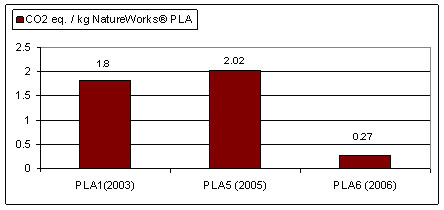
The fossil fuel energy required to produce PHA is 50.4 MJ/kg. Other estimates value between 50-59 MJ/kg. NatureWorks speculates that technological advancements using Wind power and biomass driven strategies will reduce the fossil fuel dependence to 16.6 MJ/kg. In contrast, polypropylene and high density polyethylene require 85.9 and 73.7 MJ/kg respectively. Gerngross reports a 2.65 total fossil fuel energy equivalent (FFE) required to produce a single kilogram of PHA, while polypropylene only requires 2.2 kg FFE. Any biodegradable polymer alternative will need to take into account the priorities of society with regard to energy, environment, and economic cost. It must also be taken into consideration that the technology to produce PHA is still in its latent stage and elimination of the fermentation step may further reduce energy consumption. The dependence from corn may be shifted to sugar to lower energy requirements. Many biodegradable polymers that come from renewable resources (i.e. starch-based, PHA, PLA) also compete with food production, as the primary feedstock is currently corn. Recent developments in the commercial production of PLA by NatureWorks has eliminated some dependence of fossil fuel-based energy by supplanting it with wind power and biomass-driven strategies. They report making a kilogram of PLA with only 27.2 MJ of fossil fuel-based energy. Currently, it takes 2.65 kg of corn to make 1 kg of PLA. Since 270 MT of plastic are made every year, replacing conventional plastic with corn-derived PLA would remove 715 MT from the world's food supply. 

Environmental benefits

Methane is released when any biodegradable material degrades in an anaerobic environment. Methane production from 594 managed landfill environments is captured and used for energy.

Food scraps and wet, non-recyclable paper comprise 50 million tons of municipal solid waste. Biodegradable plastics can replace the non-degradable plastics in these waste streams, making municipal composting a significant tool to divert large amounts of otherwise non-recoverable waste from landfills.

Compostable plastics combine the utility of plastics (lightweight, resistance, relative low cost) with the ability to completely and fully compost in an industrial compost facility. Rather than worrying about recycling a relatively small quantity of commingled plastics, proponents argue that certified biodegradable plastics can be readily commingled with other organic wastes, thereby enabling composting of a much larger position of nonrecoverable solid waste. Commercial composting for all mixed organics then becomes commercially viable and economically sustainable. More municipalities can divert significant quantities of waste from overburdened landfills since the entire waste stream is now biodegradable and therefore easier to process.

The use of biodegradable plastics, therefore, is seen as enabling the complete recovery of large quantities of municipal sold waste (via aerobic composting) that have heretofore been unrecoverable by other means except land filling or incineration.

References
  1. Harris W. How long does it take for plastics to biodegrade?
    http://science.howstuffworks.com/science-vs-myth/everyday-myths/how-long-does-it-take-for-plastics-to-biodegrade.htm
  2. Co-op launches biodegradable bags but question raised over reuse. Lets recycle. 2002.
    http://www.letsrecycle.com/news/latest-news/packaging/co-op-launches-biodegradable-bags-but-question-raised-over-reuse
  3. BPI assessment of oxo-biodegradable films
    http://www.biobags.co.uk/images/BPI%20Assessment%20of%20Oxos%20v1.pdf
  4. Pearce F. Biodegradable plastic bags carry more ecological harm than good. 2009.
    http://www.theguardian.com/environment/cif-green/2009/jun/18/greenwash-biodegradeable-plastic-bags
  5. Yabannavar A V and Bartha R. Methods for Assessment of Biodegradability of Plastic Films in Soil. 1994.
  6. Bonhomme S, Cuer A, Delort A-M, Lemaire J, Sancelme M and Scott G. Environmental degradation of polyehyene.
    http://www.epi-global.com/files/scientific_publication/1247509620Environmental%20Biodegradation%20of%20PE.pdf
  7. Journal of Polymer Degradation & Stability. Vol 96. p 919-928. 2011.
  8. Biodegradable plastic.
    http://en.academic.ru/dic.nsf/enwiki/3059313#sel=60:187,60:203

05 July, 2017

Parents

If you live to be in your 20s, chances are that your parents screwed some things up for you during your childhood. And as you “grow up”, you start noticing these little screw-ups. Going through this phase is always a painful process and almost inevitably kicks in a lot of despair and depression. Thing is, your mom and dad are not your all-knowing protectors, guardians, and saviors as you still expect them to be. Nor are they the obnoxious and totally uncool authoritarians which you convince yourself that they are. They are… two normal human beings – flawed, vulnerable, struggling. The only difference is that they make their best effort despite often having no clue of what the hell they’re doing, even if they don’t know what the best thing is.

And in that they screw up. They forget that they are coping with other human beings, who grow up, think, learn, cry, and have a life of their own. For parents it’s very difficult to forget the image of the helpless infant who wasn’t even potty-trained. So when the infant one day suddenly creates an opinion, the first instinct parents have is that it’s wrong, or at least flawed. Because this kid can’t possibly match the years of experience and hardship we have endured, and the lessons we learnt from them, right? In doing so parents develop a perception that they know what’s right for the kid. This soon transitions to the belief that if parents are doing something for the kid, it automatically becomes for the kid’s benefit. Well, that’s bullshit!

Knowing right from wrong comes with experience and knowledge, and even then the wisest of us make mistakes. Parents don’t always instinctively know what the best is for their children. They can only attempt at making the judgment which according to themselves is the best. Their judgment might not always be right. Parents do not have a divine knowledge of what’s best for their kids. And you know what? That’s okay.

A fear parents always have is that the children might not be able to cope up without them. And parents spend a lifetime trying to create a “good” life for the children after they are gone. In this pursuit of happiness for their children, parents sometimes forget to give their children a good life while they are around. They’ll scold, thrash, and scorn the children for mistakes they do not want to transform into habits. Basically, they want all their good traits and none of their bad traits in their children, which is a noble pursuit. But this leaves the child craving for love, care, and compassion. Children seldom want your money or inheritance. They settle for it because that’s all they are left with. And they accept it as a way of life. As a very good friend of mine told me once, we can’t afford to forgo the love in the present to secure comfort in a future whose existence is not secured. If only we tried to keep today full of love, we wouldn’t have to worry about the future.

To the children I say this. If you are the kind of person who would happily give up your own needs and desires for the happiness of your parents, then you are looking forward to a life of despair and regret. But it is one that you have chosen for yourself. You have bonded yourself into slavery and like a slave now you must exist. Your opinions and wants henceforth do not matter and your life is going to be one pre-determined by your parents – unless the forces of the world choose otherwise.

Else, you may choose to take your own stand and suffer the consequences your decisions have brought upon yourself. You are the master of your life and a slave to the consequences of your decisions. No one but yourself is to be blamed for your life. There is an expiry date on till when you can blame your parents for your failures, and you are well past that. 

07 June, 2017

The Harbor Line - Masked City

Looking out through the glass,
the view is not so nice
There’s an expanse of a slum
rigged in poverty, decay, and vice

It’s bigger than any he’d ever seen before
stretching out on both ends of his sight
It stretches out as far as his eyes allow him to see
only restricted when the window on the wall might

It creeps upon a hill, and still climbing up he reckons
only stopping, where the hill sees a bend
Perhaps it would go over the hill someday,
and start coming down from the other end

Humans live there, millions of them in in small huts
Disgusting to see, poverty, dust, scavengers and shit
He watches them from the 15th floor,
easily ignorable, for he finds the sky at his feet

He can choose to see the sky, crisp blue and majestic in size
or he may gaze the hill, covered with lush green trees
Not the perfect picture, but it does have its good parts
Raising his eyes, he may choose what he sees

But he sees the slum, the millions the plight the hardships the pain
the scowls the struggle the darkness the bane
He chooses to ignore the trees the sky the birds the lights
He wakes up every day, and contemplates the plights

But, every night when he comes back home
there is no sky or hill or trees green
Darkness engulfs the area, shadowing the landscape
only a splendid array of stars to be seen

Not in the sky, for the city sky has no stars
Each little hut lights one little bulb, and that’s where the stars are
Each lighted up at night, casting out darkness from their homes
Together, lighting his nights up, leaving no trace of their scars

Each light rests against the pitch black sky
Millions of them together, stretching out on both ends of his sight
It stretches out as far as his eyes allow him to see
only restricted when the window on the wall might

It suddenly stops going up,
into the black sky his lights are lost
at nights he lives among the stars

beautiful, mesmerized, engrossed

A pleasant picture to come home to
and he comes home to it every night
to think that something so hideous during the day
can fill his heart with such delight

Perhaps that is the price of beauty
The wounds that make us bleed
they leave scars of glory to contemplate
like he likes to watch them to sleep

He contemplates his own life
his thoughts on his mind and their nitty-gritties
Looking into the glass, he sees his own reflection
and he sees himself, amidst his masked city

Vishal Gupta
21 August 2016

30 May, 2017

Gatekeeper

Solemn, silent, standing, smiling
Deep thoughts hiding behind deep eyes
Watching her from afar, taking guard
admiring, the Gatekeeper

She takes her stance every morning
Smiling at every passer-by, taking their names
Perhaps she realizes not that she
makes hundreds of beginnings with a smile everyday

I look upon her from a distance
so engrossed in her work is she
But my gaze brings her attention to me
and happily then she smiles and waves at me

Perhaps she has found a friend in me,
perhaps it’s not me but her smile she’s being honest with
perhaps she is just doing her job
hiding joys and sorrows and love and pain behind a façade

But the heart cares little for such depths right now
The heart desires just to stare at her Graceless being
A twitch of her hand when she settles her hair
A look at my eyes when she tries to find respite

Now I know better to fall for a smile,
And I’ve been a fool and I’ve been blind
I have not fallen for the damsel in front of my eyes
I only wish to sit across her and want her to pour her heat out

I wish to know what she knows and feel what she feels
I wish to know her life story and how she became what she is
I wish to know the secret behind her stance and smile
I wish to hold her hand and dance through the night

Crowds pass by her every day
Some she remembers, some remember her
but like all citizens of the modern connected world
I wonder does she feel alone in some way

Does she go back home, thankfully away from the crowd
And sit in silence away from the noise
Or does another kind of loneliness engulf her,
one you realize only when you spend time too much in a crowd

I don’t know, I only saw a girl and admired a smile
And perhaps wish to see that smile again,
and again, and again, and more, and more
Sharing the deep thoughts behind deep eyes
Coming close, for her to shed her guard
the secrets of the Gatekeeper

Vishal Gupta
3 November 2016