03 August, 2017

A Study On Bio-Degradable Plastics

Since their creation, plastics have revolutionized the world. Being easily moldable and the ability to transform into any shape of any size, plastics have found uses in a wide application of household as well as commercial uses replacing glass, wood, steel. However, unlike conventional materials, plastics are immune to bio-degradation: a process where products are transformed into lesser compounds by bacteria in the soil. Some plastics may be able to break down plastics, however, it remains a remote and expensive method. The only real way to decompose plastics is by UV-radiation which breaks the bonds in the long molecular chain breaking down plastic into lots of little pieces. However, plastic buried in landfills rarely see light of day. Plastics dumped in the ocean are exposed to light, and do degrade in as less as an year. Yet, the resulting small bits of plastic end up in sea-animals and shorelines in toxic form. The solution proposed is biodegradable plastic. Currently, there are 2 types of of biodegradable plastics on the market –
  1. Plant-based hydro-biodegradable plastic
  2. Petroleum-based oxo-biodegradable plastic
In the Plant-based hydro-biodegradable plastic category, polylactic acid (PLA), a plastic made from corn, is the most popular alternative. In perfect conditions PLA is decomposable in water and carbon-dioxide in 47-90 days, i.e. 25% of the time taken by PET-based plastics.

These alternatives are collectively known as bioplastics, deriving their sources from renewable raw materials, petrochemicals and biodegradable additives which catalyze biodegradation.

Bioplastics are generally categorized in the following fashion.


Problems with bio-degradable plastics

Ideally, biodegradable plastics should completely metabolize to carbon-dioxide and water. For example, plastics made from starch could be carbon neutral, though widespread use poses a danger of food security.

Oxo-degradable plastics are plastics made using cobalt, iron or manganese which degrade in presence of oxygen and sunlight. Symphony, which supplies these bags to Co-op and Tesco, claims that its bags degrade 97% faster than standard bags. Tesco reckons that they decompose in half that time without leaving anything that could harm the environment. However, it has seldom been questioned where do these plastics gets the oxygen and sunlight from when they are buried in a landfill. Also, a study by the Biodegradable Products Institute found that the breakdown depends heavily on conditions like high temperature and low humidity. Also, manganese reacts with ammonia and other gases generated by microorganisms in the landfill which stops the breakdown. Besides, high quantities of lead and cobalt are used in some brands of these plastics raising questions about the toxicity of the leftovers. The European Plastic Recyclers Association further argues that plastics are manufactured with a lot of inputs from non-renewable resources; making it economically disastrous to create plastic bags made to self-destruct. In March 2008, the New York Times announced that it would not wrap its paper in bio-degradable plastics as they did not live up to their 100% biodegradable claims. Following this, the US Council of Better Business Bureaus ruled that makers should stop calling these bags “eco-friendly”. In contrast, the UK Periodical Publishers Association made a recommendation in 2007 that all its members should use oxo-biodegradable film to wrap their magazines. Symphony claims that Soil Association buys their bags. However, Clio Turton from the Soil Association says that they’re very frustrated with people making such claims. The British consume 8 billion plastic bags per year, hence for them these bags become a big environmental consideration.

GPC measurements demonstrate that biodegradation claims were confined to the additives and the PE and PVC polymers were not degraded. Carbon dioxide evolution is found to be a useful screening tool for plastic film biodegradation, but for films with additives, polymer biodegradation needs to be confirmed by GPC. Photochemical cross-linking of polymer strands reduces solubility and may interfere with GPC measurements of polymer degradation. It is observed that microbial growth occurs on the presence of PE samples that have been compressed to thick sections but had not been pre-oxidized. Molecular enlargement and broadening of molecular weight distribution occurs after preheating in the air at 60ᵒC but not at ambient temperatures but colonization of microorganisms occurs on all samples. Erosion of the film surface is observed in the vicinity of the microorganisms and the decay of oxidation products in the surface of the polymer film is measured and is found to be associated with the formation of protein and polysaccharides, attributed to the growth of microorganisms.

The Oxo-biodegradable Plastics Association argues that OBD plastics contain salts of metals, not metals themselves, which are not prohibited by law. Infact, they are necessary elements in the human diet. When tested in accordance with ISO 17556, a peer-reviewed report by the joint effort of the Technical Research Institute of Sweden and the Swedish University of Agricultural Sciences shows that 91% of OBD plastics are biodegraded in a soil environment within 24 months.
Costs of Production 

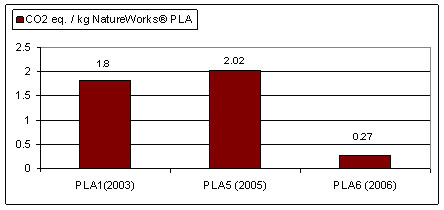
The fossil fuel energy required to produce PHA is 50.4 MJ/kg. Other estimates value between 50-59 MJ/kg. NatureWorks speculates that technological advancements using Wind power and biomass driven strategies will reduce the fossil fuel dependence to 16.6 MJ/kg. In contrast, polypropylene and high density polyethylene require 85.9 and 73.7 MJ/kg respectively. Gerngross reports a 2.65 total fossil fuel energy equivalent (FFE) required to produce a single kilogram of PHA, while polypropylene only requires 2.2 kg FFE. Any biodegradable polymer alternative will need to take into account the priorities of society with regard to energy, environment, and economic cost. It must also be taken into consideration that the technology to produce PHA is still in its latent stage and elimination of the fermentation step may further reduce energy consumption. The dependence from corn may be shifted to sugar to lower energy requirements. Many biodegradable polymers that come from renewable resources (i.e. starch-based, PHA, PLA) also compete with food production, as the primary feedstock is currently corn. Recent developments in the commercial production of PLA by NatureWorks has eliminated some dependence of fossil fuel-based energy by supplanting it with wind power and biomass-driven strategies. They report making a kilogram of PLA with only 27.2 MJ of fossil fuel-based energy. Currently, it takes 2.65 kg of corn to make 1 kg of PLA. Since 270 MT of plastic are made every year, replacing conventional plastic with corn-derived PLA would remove 715 MT from the world's food supply. 

Environmental benefits

Methane is released when any biodegradable material degrades in an anaerobic environment. Methane production from 594 managed landfill environments is captured and used for energy.

Food scraps and wet, non-recyclable paper comprise 50 million tons of municipal solid waste. Biodegradable plastics can replace the non-degradable plastics in these waste streams, making municipal composting a significant tool to divert large amounts of otherwise non-recoverable waste from landfills.

Compostable plastics combine the utility of plastics (lightweight, resistance, relative low cost) with the ability to completely and fully compost in an industrial compost facility. Rather than worrying about recycling a relatively small quantity of commingled plastics, proponents argue that certified biodegradable plastics can be readily commingled with other organic wastes, thereby enabling composting of a much larger position of nonrecoverable solid waste. Commercial composting for all mixed organics then becomes commercially viable and economically sustainable. More municipalities can divert significant quantities of waste from overburdened landfills since the entire waste stream is now biodegradable and therefore easier to process.

The use of biodegradable plastics, therefore, is seen as enabling the complete recovery of large quantities of municipal sold waste (via aerobic composting) that have heretofore been unrecoverable by other means except land filling or incineration.

References
  1. Harris W. How long does it take for plastics to biodegrade?
    http://science.howstuffworks.com/science-vs-myth/everyday-myths/how-long-does-it-take-for-plastics-to-biodegrade.htm
  2. Co-op launches biodegradable bags but question raised over reuse. Lets recycle. 2002.
    http://www.letsrecycle.com/news/latest-news/packaging/co-op-launches-biodegradable-bags-but-question-raised-over-reuse
  3. BPI assessment of oxo-biodegradable films
    http://www.biobags.co.uk/images/BPI%20Assessment%20of%20Oxos%20v1.pdf
  4. Pearce F. Biodegradable plastic bags carry more ecological harm than good. 2009.
    http://www.theguardian.com/environment/cif-green/2009/jun/18/greenwash-biodegradeable-plastic-bags
  5. Yabannavar A V and Bartha R. Methods for Assessment of Biodegradability of Plastic Films in Soil. 1994.
  6. Bonhomme S, Cuer A, Delort A-M, Lemaire J, Sancelme M and Scott G. Environmental degradation of polyehyene.
    http://www.epi-global.com/files/scientific_publication/1247509620Environmental%20Biodegradation%20of%20PE.pdf
  7. Journal of Polymer Degradation & Stability. Vol 96. p 919-928. 2011.
  8. Biodegradable plastic.
    http://en.academic.ru/dic.nsf/enwiki/3059313#sel=60:187,60:203

05 July, 2017

Parents

If you live to be in your 20s, chances are that your parents screwed some things up for you during your childhood. And as you “grow up”, you start noticing these little screw-ups. Going through this phase is always a painful process and almost inevitably kicks in a lot of despair and depression. Thing is, your mom and dad are not your all-knowing protectors, guardians, and saviors as you still expect them to be. Nor are they the obnoxious and totally uncool authoritarians which you convince yourself that they are. They are… two normal human beings – flawed, vulnerable, struggling. The only difference is that they make their best effort despite often having no clue of what the hell they’re doing, even if they don’t know what the best thing is.

And in that they screw up. They forget that they are coping with other human beings, who grow up, think, learn, cry, and have a life of their own. For parents it’s very difficult to forget the image of the helpless infant who wasn’t even potty-trained. So when the infant one day suddenly creates an opinion, the first instinct parents have is that it’s wrong, or at least flawed. Because this kid can’t possibly match the years of experience and hardship we have endured, and the lessons we learnt from them, right? In doing so parents develop a perception that they know what’s right for the kid. This soon transitions to the belief that if parents are doing something for the kid, it automatically becomes for the kid’s benefit. Well, that’s bullshit!

Knowing right from wrong comes with experience and knowledge, and even then the wisest of us make mistakes. Parents don’t always instinctively know what the best is for their children. They can only attempt at making the judgment which according to themselves is the best. Their judgment might not always be right. Parents do not have a divine knowledge of what’s best for their kids. And you know what? That’s okay.

A fear parents always have is that the children might not be able to cope up without them. And parents spend a lifetime trying to create a “good” life for the children after they are gone. In this pursuit of happiness for their children, parents sometimes forget to give their children a good life while they are around. They’ll scold, thrash, and scorn the children for mistakes they do not want to transform into habits. Basically, they want all their good traits and none of their bad traits in their children, which is a noble pursuit. But this leaves the child craving for love, care, and compassion. Children seldom want your money or inheritance. They settle for it because that’s all they are left with. And they accept it as a way of life. As a very good friend of mine told me once, we can’t afford to forgo the love in the present to secure comfort in a future whose existence is not secured. If only we tried to keep today full of love, we wouldn’t have to worry about the future.

To the children I say this. If you are the kind of person who would happily give up your own needs and desires for the happiness of your parents, then you are looking forward to a life of despair and regret. But it is one that you have chosen for yourself. You have bonded yourself into slavery and like a slave now you must exist. Your opinions and wants henceforth do not matter and your life is going to be one pre-determined by your parents – unless the forces of the world choose otherwise.

Else, you may choose to take your own stand and suffer the consequences your decisions have brought upon yourself. You are the master of your life and a slave to the consequences of your decisions. No one but yourself is to be blamed for your life. There is an expiry date on till when you can blame your parents for your failures, and you are well past that. 

07 June, 2017

The Harbor Line - Masked City

Looking out through the glass,
the view is not so nice
There’s an expanse of a slum
rigged in poverty, decay, and vice

It’s bigger than any he’d ever seen before
stretching out on both ends of his sight
It stretches out as far as his eyes allow him to see
only restricted when the window on the wall might

It creeps upon a hill, and still climbing up he reckons
only stopping, where the hill sees a bend
Perhaps it would go over the hill someday,
and start coming down from the other end

Humans live there, millions of them in in small huts
Disgusting to see, poverty, dust, scavengers and shit
He watches them from the 15th floor,
easily ignorable, for he finds the sky at his feet

He can choose to see the sky, crisp blue and majestic in size
or he may gaze the hill, covered with lush green trees
Not the perfect picture, but it does have its good parts
Raising his eyes, he may choose what he sees

But he sees the slum, the millions the plight the hardships the pain
the scowls the struggle the darkness the bane
He chooses to ignore the trees the sky the birds the lights
He wakes up every day, and contemplates the plights

But, every night when he comes back home
there is no sky or hill or trees green
Darkness engulfs the area, shadowing the landscape
only a splendid array of stars to be seen

Not in the sky, for the city sky has no stars
Each little hut lights one little bulb, and that’s where the stars are
Each lighted up at night, casting out darkness from their homes
Together, lighting his nights up, leaving no trace of their scars

Each light rests against the pitch black sky
Millions of them together, stretching out on both ends of his sight
It stretches out as far as his eyes allow him to see
only restricted when the window on the wall might

It suddenly stops going up,
into the black sky his lights are lost
at nights he lives among the stars

beautiful, mesmerized, engrossed

A pleasant picture to come home to
and he comes home to it every night
to think that something so hideous during the day
can fill his heart with such delight

Perhaps that is the price of beauty
The wounds that make us bleed
they leave scars of glory to contemplate
like he likes to watch them to sleep

He contemplates his own life
his thoughts on his mind and their nitty-gritties
Looking into the glass, he sees his own reflection
and he sees himself, amidst his masked city

Vishal Gupta
21 August 2016

30 May, 2017

Gatekeeper

Solemn, silent, standing, smiling
Deep thoughts hiding behind deep eyes
Watching her from afar, taking guard
admiring, the Gatekeeper

She takes her stance every morning
Smiling at every passer-by, taking their names
Perhaps she realizes not that she
makes hundreds of beginnings with a smile everyday

I look upon her from a distance
so engrossed in her work is she
But my gaze brings her attention to me
and happily then she smiles and waves at me

Perhaps she has found a friend in me,
perhaps it’s not me but her smile she’s being honest with
perhaps she is just doing her job
hiding joys and sorrows and love and pain behind a façade

But the heart cares little for such depths right now
The heart desires just to stare at her Graceless being
A twitch of her hand when she settles her hair
A look at my eyes when she tries to find respite

Now I know better to fall for a smile,
And I’ve been a fool and I’ve been blind
I have not fallen for the damsel in front of my eyes
I only wish to sit across her and want her to pour her heat out

I wish to know what she knows and feel what she feels
I wish to know her life story and how she became what she is
I wish to know the secret behind her stance and smile
I wish to hold her hand and dance through the night

Crowds pass by her every day
Some she remembers, some remember her
but like all citizens of the modern connected world
I wonder does she feel alone in some way

Does she go back home, thankfully away from the crowd
And sit in silence away from the noise
Or does another kind of loneliness engulf her,
one you realize only when you spend time too much in a crowd

I don’t know, I only saw a girl and admired a smile
And perhaps wish to see that smile again,
and again, and again, and more, and more
Sharing the deep thoughts behind deep eyes
Coming close, for her to shed her guard
the secrets of the Gatekeeper

Vishal Gupta
3 November 2016

11 May, 2017

Being an IITian (unabashed version)

I graduated from IIT Kharagpur in 2013. This year I complete as many years outside those gates as I had spent in the campus. Over the course of the last four years I have met with countless people with numerous questions regarding life at IIT ranging from hushed topics like ragging, sex ratio, and Arvind Kejriwal to those which people feel are a matter of public discourse like placements, subsidies, and… well Arvind Kejriwal.
But the most persistent question of all has been this – “What was the use of studying engineering if you wanted to pursue MBA and investment banking.” And the question is asked with such animosity that I fail to understand if it is rooted in idle curiosity or mere jealousy. So that this point I wish to take it upon myself for the sake of my community I dearly love to answer this question. But before I do, let’s dig a little deeper into the question – What does it mean to be an IITian?
A much as it would surprise the world at large, I think this truth needs to be revealed for once and for all. IITians are people! Let’s read that again and think about it for a moment. IITians are people! Even those who bag Crore rupee packages, about whom reporters from Times of India (who have never heard of the term “purchasing power parity”) so gladly exaggeratedly publish. IITians are people! Including the ones who go abroad. Even those who sit next to you in the office and do the same work as you do. They do not consider themselves superior to you. They do not consider themselves inferior to you. They just consider themselves as people. While some might wonder how come a graduate from an “elite” university can live the same stereotypical average normal life as you do, it is a question that would never cross their own minds.
Take a moment to imagine life at IIT. For 4-5 years the kid is surrounded by hundreds if not thousands of people who “don the IIT tag”. It is not elite or special or high-profile. Its everyday life. For four years. It is not until that kid graduates that he realizes that there are people who consider them to be a unique breed. “So what?” he thinks. They’re people. Sadly, these “people” are incapable of seeing the other person as anything beyond an “IIT tag”. They never understand that IITs are like any other university. There were students who topped the class and there were those who were at the bottom of the class and there were those who had to repeat a year. There was a time when everyone at IIT was confused about where to go with their careers. And most kids there opt to spend the entirety of their lives in the same rat race as the majority of the world does.
By now I can almost feel the comments – “So what’s the point of IIT? Why put so much tax money in them? What’s the point if all we are going to produce are average people, people who go abroad, and what about Arvind Kejriwal?”
For starters, there’re the regular answers. The largest repository for online video lectures in the world, NPTEL with over 4k hours of content, 69k subscribers, and 44.7M hits. While the cynics focus on Arvind Kejriwal IITs have produced alumni of irrefutable repute like Narayan Murthy, Sachin and Binny Bansals, Sundar Pichai, Manohar Parrikar, Raghuram Rajan, Pranav Mistry, Vinod Khosla, (pause for breath) Kiran Bedi, Jairam Ramesh, Rajat Gupta, Arunabh Kumar, Biswapati Sarkar, Nandan Nilekani, and these are only the ones who are still alive. 270 of the Fortune 500 India companies have an IITian on their board. Lastly, a study by Zinnov Consulting shows that the investment on IITians in the last five decades ranges between Rs 20-40k Cr while the contribution by IITians to the economy is around Rs 20 lakh Cr.
But all this is numbers and theory. That’s not what people want. They need the answer to be personal. They wonder what is the point of having a colleague or competitor being an IITian if they do the same work. Actually, they do not wonder. They know with absolute certainty that he struggled unnecessarily and feel proud that they reached the same place taking a much easier path. Hence, they “won at life”, aka the rat race.
Here’s where I differ. The next time you see that IITian colleague of yours just consider his demeanor for a moment. IITians are a humble lot. Society puts them on a pedestal. They are used to living in 77 sqft boxes and showering in a common bathroom. Four years of peers who excel at things ranging from music to robotics instills humility. No matter how good I get at anything I always know a close friend who started out as the same as me and has done it better. Consider the kind of psyche such a person likely to develop. For very formative four years of his life he studied played and ate with people whom he referred to as “friends”. It was the society outside who counted them as different.
Secondly, notice if he is at ease with himself. Is he more or less open in accepting your quirks and eccentricities? Is he socially inept, rebellious, or just struggling to fit in despite his personality conditioned in those years at IIT. Think of how that would have developed. A difference between a good college and any other institution is the amount of freedom given to the students and how students use that freedom. IITs are among the ones who get that right. They not only provide their students with time and opportunity to pursue their passions but also leave no stone unturned in nurturing that passion with the right infrastructure. You like music? Here’s a sound proof room with the latest equipment. You don’t want to use the music room and take the drums to your room? Sure why not! The other kids won’t mind if you’re good enough. Ok. So now you don’t want to play drums but build an iron-man suit for the army? Here’s the money and a team of like-minded people. So you want to take a job because you lack the entre entrepreneurial spirit to sell your invention? Well, no problem. You tried honestly. Move on.
IITians are bred in an environment where we learn to be at ease with the decisions we take. Accepting ourselves for who we are. How is it in adulthood before that privilege is taken from us? Social pressures and stigma forces people to live their entire lives wearing masks. IITians are generally uncomfortable with that. We prefer to embrace our eccentricities rather than be embarrassed by them. In process, fighting the uphill battle of the social system. Of you and your animosity.
Lastly, I do acknowledge all the black sheep of my fraternity whom too many people quite callously take liberty in making fun of. But try to notice that no IITian would ever join you in making fun of them. It’s called camaraderie. Look it up. It amazes me how that concept is so lost in the lives of normal everyday people. But the next time your IITian colleague talks to you about his alma mater, take a moment to notice your own feelings. The envy isn’t because he got to go to a more famous establishment. What you feel might be envy arising out of the realization that unlike him, you never knew a time in your life when you were free to pursue your dreams, accepted for who you were, surrounded by people better than you, and yet surrounded by friends.
An IITian understands what “passion for life” feels like even though he might not feel it right now. He has known it in the past. And since he has come out of those majestic gates, he has craved to feel it again. It’s not his tag that makes you jealous. It’s his ability to love a time in his own life so dearly. Not too many people are blessed with 4 continuous years of magic.
Perhaps that was the point of being an IITian. I’m not very sure. After all I’m just a bad engineer trying to survive in the rat race. You cannot trust someone with those credentials, can you? But do watch out for me in case I’m in the same race as you. Chances are that while you were chiding me for having better shoes, I might have taken the lead.